
If you are going to be attending the Institute of Animal Technology (IAT) Congress this year, we look forward to seeing you at the conference. The team have been working hard in preparation for this year’s show and we are looking forward to another great meeting held by the IAT.
We are looking forward to seeing technicians, clients and industry colleagues at the meeting and networking with like minded professionals from the life science industry.
Don’t forget to visit the Agenda stand in the trade exhibition and see whether you can make our Congress Leader board challenge. The team are looking forward to seeing you.
The main purpose of the Congress is to introduce Animal Technologists to the latest developments in all aspects of animal-based research and technology.
For more information about IAT Congress visit www.iat.org.uk.
For the first time, researchers have been able to produce a sheep embryo that has a small amount of human genetic code. The scientific breakthrough was recently announced at the American Association for the Advancement of Science meeting in Texas. This could be very important for the future of medical technologies as researchers hope one day to grow human body parts for organ donation from genetically engineered animals.
“Even today the best-matched organs, except if they come from identical twins, don’t last very long because with time the immune system continuously is attacking them,” said Dr Pablo Ross from the University of California, Davis, who is part of the team working towards growing human organs in other species, in a media briefing reported by the Guardian.
For clarity, the embryos weren’t half human/half sheep, they were not created on a whim and without regulation and were all actually destroyed within four weeks of their creation.
The team inserted adult human stem cells inside an early-stage sheep embryo, and they followed its development over 28 days. “About one in 10,000 cells in these sheep embryos are human,” explained Ross.
While this ratio is a tiny 0.01 percent, it is much higher than scientists have previously been able to achieve for pig-human chimeras. That was closer to one human cell in every 100,000 pig cells. Sheep and pigs are used because their organs are roughly the right size to be transplanted into humans. But to actually develop an organ, the embryos would need to have about 1 percent of human cells, so we’re still a while off.
There have been ethical concerns about this threshold. Some people worry that by humanising the cellular composition of animals it could be possible to create a human-faced pig or a sheep with a human mind. The team has shown that they are capable of focusing the human cells to be able to construct specific organs.
“We have published several papers showing we can target the region, so we can avoid human cells differentiating into the human brain or human gonads,” Dr Hiro Nakauchi of Stanford University, who is also part of the team.
The road to having animals as potential organ donors is still extremely long and the challenges are not easy to overcome. For research alone, the team is planning on requesting permission to keep the embryos for longer than the current threshold of 28 days, but that’s not in any way a certainty that their approach could actually lead to a viable transplant solution.
That said, it’s important to keep working at it. In the United States alone, 117,000 people are currently on an organ donor waiting list and 22 people die each day waiting for a transplant.
After the annual December binge of food and drink, the first day of January always brings resolutions of diets and weight loss targets for the summer, however, millions of brave souls are also preparing themselves for a month-long break from alcohol. With an estimated £4.2bn spent on food and drink in the UK last Christmas it is no surprise that more and more people are opting to become temporary teetotallers in addition to the ‘January Dieters’.
Started by the UK’s Alcohol Concern organization in 2013, the movement’s main goal is to help people “reset their relationship with alcohol.” Usually once the temptations subside, when you speak to people abstaining, the feedback is quite positive, however, what effects does a month-long absence of alcohol have on the human body?
“Nothing bad,” says Jamile Wakim-Fleming, MD, a hepatologist at the Cleveland Clinic. “[Abstaining temporarily] is only going to be beneficial.” (One caveat: heavy drinkers should only quit with medical assistance, since they can experience a life-threatening form of withdrawal.)
Thirty-one days of sobriety might even help you cut back long-term: A 2016 study published in Health Psychology found that six months after the end of Dry January, people who had participated in the movement (even those who didn’t abstain for the entire month) reported having fewer drinks per day, drinking fewer days a week, and getting drunk less often.
In general, less booze is a good thing: “The effects of alcohol are cumulative,” says Dr. Wakim-Fleming (who was not involved in the study). “If people drink one glass a day starting in their teens, they may be fine after 10 or 20 years—but after 40 or 50 years, they might start to experience liver problems.”
And while it’s true that moderate drinking (that’s one drink a day for women, two for men) might improve your heart health, research suggests not everyone may experience these benefits.
Things you can expect after stopping the pop for a month include:
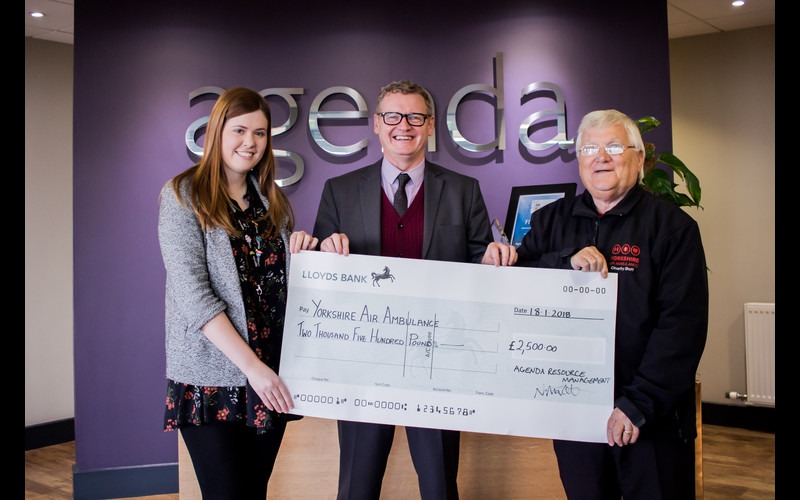
Agenda are extremely proud to present a cheque for £2,500 to the Yorkshire Air Ambulance!
2017 saw our highest ever figure raised for charity and we have some fantastic memories to go alongside it – Dress Down/Up days, Bake Sales (cheese and bacon twists were a firm favourite!), a sponsored head shave, BBQ’s, silent auctions and huge raffles!
A massive well done to Emily, our Charity Champion who organised everything – we couldn’t have done it without you! To Norman for his head shave – “baldly going where Norman has never been before”, and a huge thank you to everyone else who took part in some way!
Bob from the Yorkshire Air Ambulance was thrilled with the amount we presented to him, and confirmed that our total will fuel around 5 flights of the air ambulance.
Well done, Team Agenda – what an amazing year.
2017 marked Agenda’s 20th year in business and what a year it has been!
We’ve seen multiple event success stories such as the LASA Annual Conference last week; IAT Congress earlier in the year, and Biotechnische Dagen with Mat at our Europe offices amongst others.
We’ve seen triple audit success yet again, passing with flying colours in ISO 27001, ISO 14001 and ISO 9001.
We’ve opened a new facility at Alderley Park which welcomed Ross as Facility Manager, and Ben as our new Home Office Liaison contact and Animal Regulatory Manager to the team.
We received fantastic Great Place to Work feedback from staff, alongside amazing customer satisfaction feedback.
We said farewell to Paul as MD, he is now Charmain of Agenda, and hello to Norman who is our new Managing Director! We also gained a new Finance Director in Gary and welcomed a new addition to our Business Development Team – Josie.
Finally, our charity of the year, as you may have seen, was the incredible Yorkshire Air Ambulance. We’ve been busy all throughout the year with various charity events including dress down days, bake sales, silent auctions, raffles etc, and are pleased to announce that we have broken our previous charity record and raised the most money ever for Yorkshire Air Ambulance. We cannot wait to present them with the final number at the end of the year.
In a real breakthrough success for the regenerative medicine field, scientists have successfully grown a genetically modified replacement skin to cover almost the entire body of a 7-year-old boy suffering from a traumatic genetic disorder. Junctional epidermolysis bullosa causes the skin to become very fragile and blister.
Prior to the surgery the boy was left with untreatable, infected wounds after losing up to 80% of his skin through blistering, with only the skin on his hands, feet and face remaining. After all conventional therapies failed, the boy was given morphine for pain management and doctors prepared to commence palliative treatment.
After skin grafts were rejected from the boy’s father, the help of a group of Italian Scientists, led by Michele De Luca, was sought as a last resort. They had previously pioneered a technique that was able to regenerate healthy skin but only in a laboratory environment.
Samples were taken from the patient’s remaining healthy skin which were then genetically modified using a virus. This approach delivered a healthy version of the LAMB3 gene into the nuclei. Our skin has its own specialised supply of stem cells which allows the epidermis to be constantly renewed throughout our lives, with cells turning over on a monthly basis. This enabled the team to grow grafts in the culture by simply taking a small sample.
After the team had grown enough skin to cover almost his entire body, they attached the epidermis to his body almost like a patchwork quilt, and within a month the graft integrated into the lower layers of skin.
2 years on from his operation and the boy is doing well and has gone on to live a normal life. His skin is healthy, he does not need further medication or ointments and has an active life back at school and playing football. When his skin gets a cut, it simply heals normally.
Although it is a significant breakthrough, a potential risk of treatment in this manner is increased risk of skin cancer due to the introduction of genetic changes. There was, however, no evidence in the study of any dangerous mutations being caused and if it shown to be a safe option, the treatment could offer real hope to patients suffering from less serious severe skin disorders.
Understanding Animal Research (UAR) hosted the fourthannual Openness Awards and the 81st Stephen Paget memorial lecture on Monday, 4th December at the Wellcome Collection.
The awards celebrated four institutions and an individual who have helped further the way in which animal research is communicated in the United Kingdom.
The University of Cambridge won the Award for Website or Use of New Media for its videos explaining how animals, including non-human primates, are used to understand and treat OCD.
The winner of the Award for Media Engagement was King’s College London for its eager involvement in the documentary ‘The Monkey Lab’, allowing cameras into to see its marmosets. Harry Dayantis, previously of UCL, was highly commended for his role in bringing ten universities together to press release their animal numbers.
The Award for a Public Engagement Activity was presented to the four organisations that came together to open their labs to 3D cameras in order that the 360o virtual Lab Animal Tourcould be made. The winning institutions were MRC Harwell Institute, The Pirbright Institute, the University of Bristol and the University of Oxford. Tony Davidge, from Cancer Research UK Cambridge Institute, was also highly commended for his role in introducing local school children to the ethical and practical issues associated with animal research.
The Internal or Sector Engagement Award was presented to the Babraham Institute for their partnership with the Sopianum SGS school in Netherlands, getting its students to design and create solutions to challenging problems faced by Babraham, such as creating more effective mouse cages.
UAR’s Individual Award for Outstanding Contribution to Openness in Animal Research was presented to Rachael Buchanan and Fergus Walsh for their time and persistence in getting access and filming laboratory animals and subsequent balanced reporting at a time when ‘animal research’ evoked a knee-jerk response from much of the public and media.
Following the awards, Professor Clive Page, Head of SacklerInstitute of Pulmonary Pharmacology, KCL, delivered the 81stStephen Paget Memorial Lecture ‘How animals have helped with the discovery and development of drugs for the treatment of asthma and COPD’.
The Paget Lecture was first delivered in 1927 and has subsequently been presented by scientific luminaries including Sir Henry Dale (Nobel Prize, 1936), Sir Howard Florey (Nobel Prize, 1945) and Sir John Boyd Orr (Nobel Peace Prize, 1949). Last year the lecture was delivered by Professor Sir Mark Walport, the Government Chief Scientific Advisor.
To coincide with the Openness Awards and Paget Lecture, UAR has published the third annual report on the Concordat on Openness on Animal Research in the UK. The report details how signatories to the Concordat are fulfilling their commitments to improve openness and transparency, as well as discussing the impacts of the Concordat since it was launched.
Agenda were proud to be one of the sponsors of the 2017 Paget Lecture. Professor Clive Page talked about progress towards treating asthma and other respiratory diseases. A packed house listened to how treatments have developed, and progress made to deliver drugs directly into the lungs and giving respite for up to 3 days. Research is ongoing into these diseases that are still killing people every year. Professor Page has published over 250 research papers and in 2017 was awarded an OBE for Services to Pharmacology.


Don’t forget to enter our Christmas Game for your chance to win some fantastic prizes – score over 500 in order to get your name on the leader board and be in with the chance of winning – there’s an iPad Pro and £500 worth of holiday vouchers to be won!
Try your luck at www.agenda-christmas.co.uk
Good luck everyone!
The General Data Protection Regulation (GDPR) is coming into force on the 25th of May 2018. It’s replacing the current Data Protection Act 1998 and broadens the requirements of organisations that collect and process personal information.
Did you know that organisations found in breach of the regulation can expect administration fines of up to 4% of their annual global turnover of 20 million euro, whichever is greater?
Agenda are hosting GDPR half day workshops to help you prepare for what it is to come. With our skilled and certified GDPR Practitioner Chris Withers, you will be able to come away from our workshop with an understanding of the key changes, the impact of the new legislation, the processes that you will need to consider before becoming compliant and there will be an opportunity to discuss any specific concerns you may have.
The workshops will cover the following:
We are able to host the workshops at your premises or at our Head Office in East Yorkshire.
The workshops cost £425 (plus VAT) per session, please contact us for more information on chris.withers@agenda-screening.co.uk.
From the 28th to the 30th November, Agenda Life Sciences are going to be at the 2017 LASA Annual Conference! Come and meet the team to find out our latest news and vacancies and for your chance to enter our competitions – we have some fantastic prizes to giveaway!
As always, the team have been working hard in the run up to the event, and we’d love to meet you and have a chat about what Agenda can offer as a business. You can find us at stand 18.
If you wish to follow us whilst we’re at the conference, you can do so on our Twitter, where we will be live tweeting throughout the event.
Tim and I attended the Nottingham Trent University Science Careers Fair. The event was well attended by some leading organisations and an interesting mix of students. Amongst the companies in attendance were Envigo and Tim stopped by their stand to speak with them.
The attendees were all studying scientific degrees and covered a varied range of disciplines. Our shiny new banner stands were very well received and did the job we’d hoped for when designing them. Previous feedback we’d had at other fairs was that students couldn’t establish what we do/offer from the stands. The new designs proved a big success in this area and everyone we spoke with had gained a good insight into what we do.
In total 68 students of varying skillsets, registered their details with us for registration purposes. We spoke with a much greater number of students beyond those that signed up, however, not all were able to do so as there were lots of 1st/2nd year students.
A member of the university team stopped by the stand to discuss feedback on the day and to advise that we can advertise any roles on their website which may be suitable for graduates.
Overall it was a very productive day, we registered a great number of prospective candidates and gave a good account of the business. We received feedback from some candidates who were very grateful for having had the chance to speak with Tim and I, and that they felt it had been very beneficial to them.
Mat

As a recruiter we work with a variety of people in various different stages of their career or job searches. In this day and age it is rare for most employers and candidates to not have worked with an agency at one point or another in their lives. Here are 8 tips that you should know when working with any recruitment agency to get the most from this relationship!
At Agenda we have highly skilled scientific and animal technology experts to help in your new career, get in touch today and email hello@agendalifesciences.co.uk to speak with our consultants!